
The modern agricultural landscape is no longer just about soil and seeds; it is about data, resilience, and rapid adaptation. As global weather patterns become increasingly unpredictable, the intersection of climate change and agribusiness has created a high-stakes environment where digital literacy isn’t just an advantage, it’s a survival requirement.
For professionals looking to future-proof their careers, understanding the digital tools that drive “Climate-Compatible Development” is the ultimate strategic move.
The Growing Vulnerability of the Agricultural Sector
Agriculture remains one of the most climate-vulnerable sectors on the planet. Professionals today face a gauntlet of fluctuating weather patterns, emerging pests, and altered rainfall cycles. According to the European Commission, this vulnerability underscores a desperate need for experts who can integrate digital skills with mitigation strategies.
However, a significant bottleneck exists. The Council of the European Union has noted that digitalization in agriculture is slower than in other sectors, primarily due to infrastructure challenges and a massive “skills gap.” This gap represents a golden opportunity for those willing to specialize.
The Data-Driven Revolution in Agribusiness
The industry is already shifting its capital toward technology. Recent reports from AgTech Navigator show that 60% of agribusinesses plan to increase their agtech budgets, with a staggering 90% recognizing AI and data analytics as transformative.
But who will manage this data? The demand for “green-skilled” workers is skyrocketing. ESG Today reports that green hiring grew at nearly 8% per year globally between 2021 and 2025, while the share of workers with these skills grew at only 4.3%.
The Reality Check: Demand for green talent is growing twice as fast as the supply. According to the LinkedIn Global Green Stocktake 2025, individuals trained in climate change and sustainable development are now strategically positioned for the most lucrative and impactful roles in the global economy.
Bridging the Gap: The LUANAR eCampus Advantage
At the Lilongwe University of Agriculture and Natural Resources (LUANAR), we recognize that the digital divide is particularly sharp in developing nations. While Zipdo statistics indicate that 65% of farmers report better climate resilience through technology, only about 35% of farmers in developing countries currently possess adequate digital literacy.
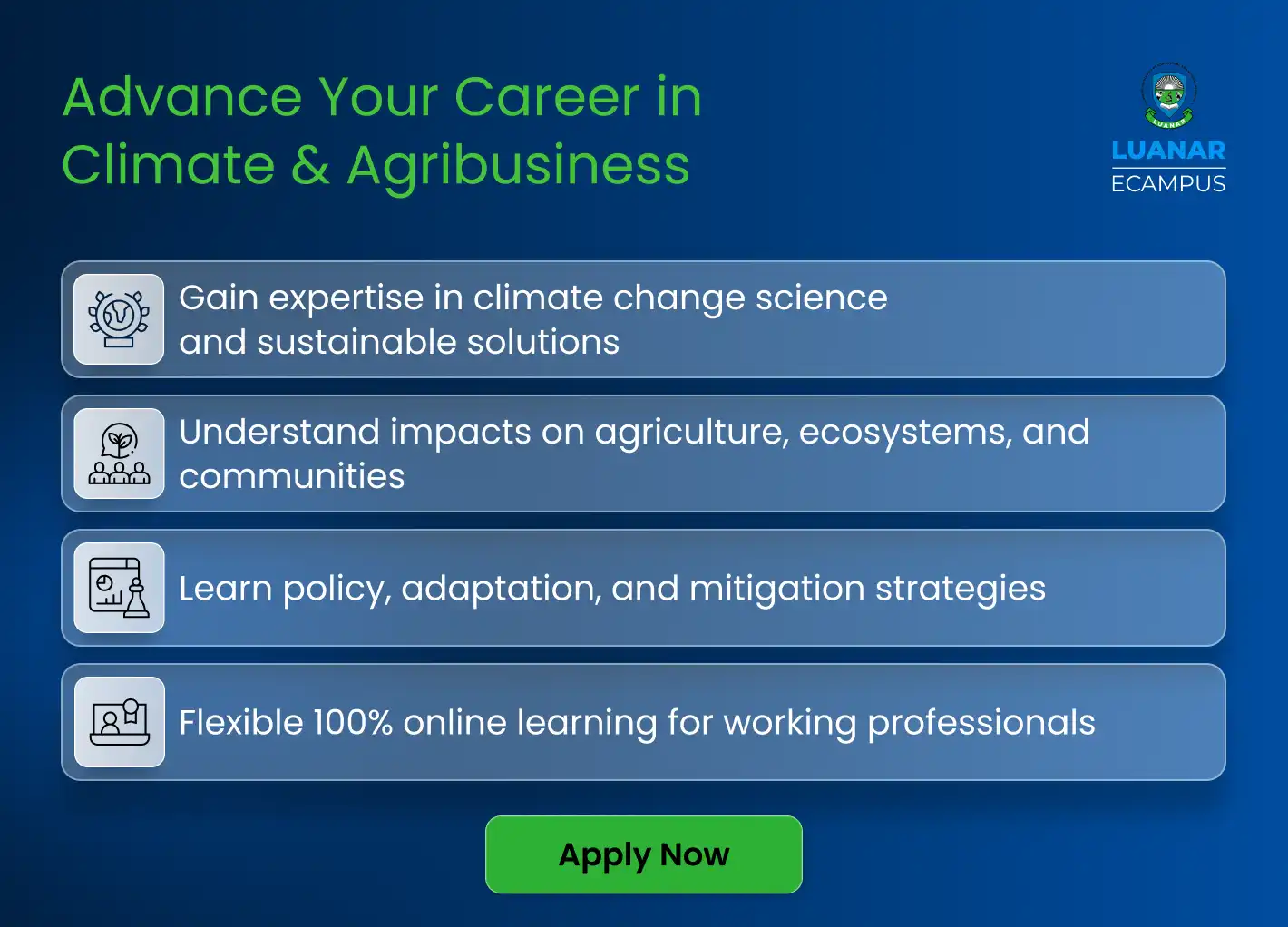
To address this, we have developed the MSc in Climate Change and Sustainable Development, a programme specifically designed to produce “World Class” graduates capable of leading the digital and green transformation in Africa and beyond.
Why Our Programme Stands Out
This isn’t just a theoretical degree. Developed in collaboration with the Southern African Regional Universities Association (SARUA), our curriculum is a regional powerhouse of knowledge. Whether you are navigating career paths in agribusiness or looking for a comprehensive guide to choosing the right Master’s, our programme offers the technical and managerial depth required for 2026 and beyond.
A Deep Dive into the Syllabus: Building Mastery
Our syllabus is structured to turn students into multidisciplinary experts. Here is what makes the LUANAR course a leader in the field:
- Foundations of Climate Science (CSD75101): You won’t just learn about the weather; you will master atmospheric energy transfer, ocean-atmosphere coupling, and the “Water-Energy-Food (WEF) Nexus.”
- Digital Tools & Geospatial Expertise (CSD75203): We provide a solid practical foundation in GIS and Remote Sensing. Graduates learn to use big data platforms (like Google Earth Engine), Machine Learning, and AI to monitor land use and model climate scenarios.
- Climate Economics & Entrepreneurship (CSD75204): This module is a launchpad for “change-makers.” It covers carbon trading, green economy innovation, and climate finance, teaching you how to unlock economic opportunities from environmental challenges.
- Science Communication (CSD75102): A skill often overlooked, we teach you how to translate complex climate data into impactful policy briefs and social media campaigns.
- Biosphere Stewardship (CSD75104): Learn to implement nature-based solutions and evaluate “planetary boundaries” (ecological tipping points).
The programme culminates in a Mini-Dissertation (CSD75299), in which students conduct impactful, evidence-based research to solve real-world problems in their respective regions.
Your Next Step Toward a Resilient Future
The gap between the demand for climate-smart professionals and the available talent is wide, but it won’t remain so forever. By choosing to specialize in Digital Transformation and Climate Development, you are placing yourself at the forefront of the most important industry shift of the 21st century.