
Starting your first semester of university is a big deal, and we know it can feel like a mix of excitement and pressure all rolled into one. You’re stepping into a brand-new chapter with fresh opportunities, new responsibilities, and maybe even a few late-night worries about whether you can juggle it all. Trust me, you can. Whether you’re showing up on campus for the first time or logging in from home through LUANAR eCampus, we’ve got you. Thriving in these first few months isn’t about being perfect, it’s about setting smart habits, leaning on the right strategies, and giving yourself room to grow.
Here are 8 practical tips to help you not just survive your first semester, but actually enjoy it and thrive. But before diving into the tips, let’s talk about something almost every new student goes through: stress and anxiety. According to BMC Psychiatry, a large study found that 75% of first-year students experience mild to severe anxiety, and 73.26% experience mild to severe stress during their very first semester. That means if you look around your class, chances are most people are feeling the same worries, nerves, or tension you might be feeling.
Anxiety often shows up as restlessness, nervousness, or racing thoughts, while stress usually comes from academic pressure, like heavy workloads, exams, and high expectations. The study also noted that female students reported stronger negative emotions on average. Depression, which can include feelings of sadness, low mood, or loss of interest, was also common (around half of first-year students), though not quite as widespread as stress and anxiety.
In other words: if you’re feeling worried, overwhelmed, or under pressure right now, you’re not alone. These feelings are common in the first semester, and there are healthy ways to manage them.
1. Don’t Skip Orientation, It’s Your Online Survival Kit
Orientation isn’t just a quick intro video or checklist you can skim through and forget, it’s your starting point for feeling confident and connected in an online learning space. Think of it as your chance to learn the “how-to” of university before classes really kick off. During orientation, you’ll get walked through the essentials: how to log into your learning portal, where to find lecture recordings, how to join live sessions, how to submit assignments, and what to do if the tech ever gives you trouble.
- Ask questions early: Don’t hesitate to jump into Q&A chats or discussion boards. For example, ask what to do if you miss a deadline, or how to reach support if your internet cuts out during a live class.
- Build your crew: Even online, you’ll meet other students in breakout rooms, group chats, or orientation forums. Swap contacts so you’ve got a peer to reach out to when coursework picks up.
- Explore your digital map: Learn where everything is in your online campus, library access, academic advising links, wellness services, and tech support. Bookmark them so you’re not scrambling later.
By the end of orientation, you should have a clear digital roadmap: your login details sorted, your course schedule saved, advisor contact info handy, and at least one or two peer connections. That way, when classes begin, you’re not lost in the system, you’re ready to go.
2. Don’t Ignore the First Weeks, Start Immediately
Many students fall into the trap of believing the first one or two weeks of university don’t really matter. They assume it’s safe to coast while courses “really get started” later. In reality, that mindset creates an invisible backlog. Professors use the opening weeks to introduce core concepts, explain assessment criteria, and assign readings that build the foundation for everything that follows. If you treat those weeks lightly, you’ll soon discover that lectures, assignments, and deadlines stack up faster than you can catch them.
A stronger approach is to act from day one. Begin by setting up a planner, mapping out deadlines, and reading ahead. For example, if your first essay is due in week six, choose your topic in week one, gather sources by week two, and outline by week three. By spreading the work across the semester, you reduce stress and create space for revisions instead of last-minute panic.
Remote learners need to be especially mindful. Without the rhythm of physically attending classes, it’s easy to underestimate how much work piles up. Logging in daily, engaging in discussion forums, and sticking to fixed study blocks prevents that early slide into procrastination. Success in your first semester isn’t about waiting until you “feel ready” to start, it’s about starting immediately, even with small steps.
3. Get to know your professors
In an online classroom, it’s easy to feel like your professor is just a face on a screen or a name on the syllabus, but they can be so much more. Professors are often the key to unlocking opportunities: mentorship, recommendation letters for internships or scholarships, research collaboration, invitations to academic conferences, guidance on graduate school applications, connections to industry professionals, and personalized advice about career paths. The catch is that online students need to be more intentional about building those relationships, since you don’t bump into professors in hallways or after class.
Imagine this: you’re taking an online economics course and get stuck on a concept in week two. Instead of quietly struggling, you drop a quick message in the course portal:
That small step opens a door. The professor might share an article, invite you to office hours, or even connect you with their own research.
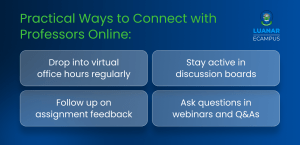
Some practical ways to make connections online:
- Attend virtual office hours regularly, even if you don’t have a big question, just check in, share what you’re learning, and show interest.
- Participate actively in discussion boards by replying thoughtfully to peers and tagging your professor with clarifying questions.
- Follow up on feedback from assignments by emailing or messaging: “I’d love to improve on this, could you recommend resources or examples?”
- Join optional webinars or recorded Q&As. Even asking one question in chat helps your professor remember you.
Professors who recognize your name and effort are far more likely to be flexible if life gets messy (like internet outages or overlapping deadlines). More importantly, they’ll see you as a motivated student and may later support you with recommendations or research opportunities.
4. Connect with at least one classmate
One trusted peer is often enough to make a big difference. Exchange contact info with someone in your tutorial or online class; start a study group; share notes. If you’re remote, set up a video chat to review lectures together; if on campus, meet in the library or study lounge.
These connections are useful when someone catches something in class you missed, you compare readings, and you prepare for exams together. On top of that, friendships have proven academic benefits. According to a study published in PMC, supportive friendships help reduce stress, provide emotional encouragement, and are directly linked to higher GPA outcomes. In other words, connecting with just one classmate doesn’t only ease the loneliness of starting university, but it can also boost your academic success.
5. Establish a dedicated study environment
Creating a study space that is free from distractions will help you stay focused and productive. Find a quiet area in your home where you can set up a desk or table for studying.
Make sure you have a comfortable chair that supports good posture to prevent discomfort or fatigue. Clear away any unnecessary items from your study area to minimise distractions and create a clutter-free space. Designating a specific area for studying will help train your brain to associate that space with focus and learning.
Research backs this up. According to a study in PMC, a well-organized physical environment, with good lighting, tidy surroundings, and overall upkeep, has a strong impact on performance. The researchers measured this effect using something called a “beta value,” which shows how strong the relationship is between two things. In this case, the beta was 0.555, which is considered a fairly large effect. In plain words: the better your study environment, the more your productivity improves.
6. Don’t overload your schedule
It’s tempting to pack many credits, electives, or side projects into the first semester to “get ahead,” but doing too much too soon can overwhelm even the most disciplined. Balance is key. Choose a mix of courses: perhaps one or two challenging ones and some lighter ones, so you have margin.
If remote, watch out for synchronous class times + deadlines + group work, which can sneak up. Make sure your course load is realistic given your outside commitments: family, work, or personal life. You can always take more in future terms.
Your first semester isn’t about perfection, it’s about foundation. Master the basics, embrace the digital advantage, and remember: every expert was once a beginner who refused to give up!
Academic Assistant Director
7. Take regular breaks to avoid burnout
While it is important to stay focused and dedicated to your studies, it’s equally important to take regular breaks to avoid burnout.
Online learning can be intensive and mentally demanding, so it is crucial to prioritise self-care and mental well-being. Incorporate short breaks into your study schedule to recharge and refresh your mind.
Use these breaks to stretch, take a walk, or engage in activities that help you relax and clear your head. Taking regular breaks not only prevents burnout but also improves focus and productivity when you return to your studies.
💡 Tip:
Take study breaks of 5 to 60 minutes to refresh your brain and body, boost concentration, and increase productivity. Breaks aren’t wasted time, they’re what allow you to perform at your best.
– Cornell Health
Remember to listen to your body and mind and give yourself time to pause when needed. Taking care of your mental health is essential for long-term success in online learning.
8. Prioritize self-care
Academic success is tied to health. Sleep, nutrition, physical movement, and mental well-being all matter. For example, if you find yourself skipping meals or staying up late too often, that catches up: concentration drops, retention suffers. Even short daily routines count: 20-25 minute walk, stretching, or a brief meditation.
For remote learners, structure your day: have consistent wake-up/sleep times, a designated workspace, and breaks. For on-campus students, use campus wellness services, counselling, or peer-support groups.
Final Thoughts
Your first semester is a launching pad for what comes next. With intention, good habits, and using the support around you, including LUANAR eCampus’s online tools, advisor support, virtual communities, and flexible learning, you can turn the pressure into progress. Thriving isn’t about never making mistakes; it’s about learning from them, growing, and finding balance.